
Event Recap: The Alabama Solution Screening and Talkback
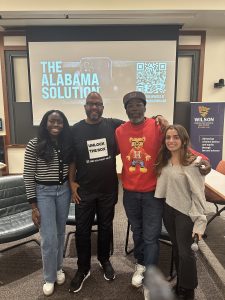
Last month, we were privileged to partner with the Duke Justice Project, Duke's undergraduate group focused on advancing criminal justice, to host a screening and talkback of HBO's The Alabama Solution.
The film exposes abuses and neglect in Alabama's prison system, including beatings and deaths in custody, rampant drug use, lack of adequate resources, and reprisals, all of which were documented in a U.S. Department of Justice investigation and lawsuit. It also catalogues incarcerated people's efforts to improve their conditions through collective action. Along with traditional documentary filmmaking, the film also relies on footage shot with contraband cell phones by Robert Earl Council, Melvin Ray, and Raoul Poole.
After the film screening, we were honored to have Dr. Craig Waleed, Project Manager of North Carolina Disability Rights's Unlock the Box Campaign Against Solitary Confinement as well as Daquan Peters, both of whom are formerly incarcerated, share their experiences and discuss how the themes in the film relate to North Carolina prisons. Duke Justice Project Co-Presidents Samantha Richter and Vivian Sekandi moderated the discussion.
Mr. Peters saw a lot of similarity between how the Alabama prison system was portrayed and his experience in North Carolina. “What you saw up there was psychological violence," he said. "I see a complete resemblance in the North Carolina system.” The film showed the callousness and disregard that many incarcerated people experience, and Mr. Peters noted that there is often a lack of focus on rehabilitation. “If prison is designed to rehabilitate you, why is the first thing they do to strip you of your identity?” he asked.
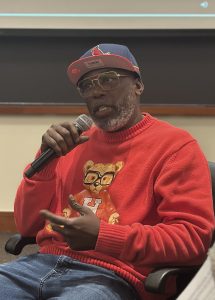
“The carceral experience is dehumanizing. Being in there strips you of your humanity," added Dr. Waleed.
These effects are long lasting and long reaching. The vast majority of incarcerated people will return back to their communities after incarceration. “I’ve been out of prison thirty years, but a lot of my experience is still shaped by my experience in prison,” said Dr. Waleed. “Most of us are going to return back to the community. How do you think they’re going to respond after they’ve been treated like that…That becomes a public health issue, a public safety issue.”
"You have people who come home worse than they came in," added Mr. Peters.
Dr. Waleed currently works to end solitary confinement, something many people in the film had experienced. While the film showed abuses throughout the experience of incarceration, Dr. Waleed and Mr. Peters noted the particular dangers of solitary confinement. "It's soul murder," said Mr. Peters.
Dr. Waleed explained more about the conditions of solitary: “People placed in solitary have an increased risk of early death, an increased risk of recidivism, and an increased risk of developing psychosis. For people who already have a psychiatric condition, this is exacerbated by solitary,” he said. "A solitary confinement cell is about the size of the spot you parked in tonight."
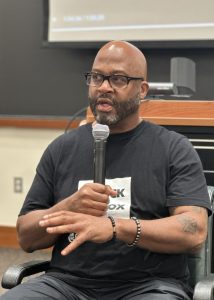 Something both the film and our panelists took care to point out is that the dehumanizing and traumatic impacts of prisons don't just affect people who are incarcerated, but also the correctional officers and people who work in prisons as well. “There’s also the people who are working there who are suffering, because of what they witness,” said Dr. Waleed. “Think about repeated exposure to trauma — what that does to the nervous system, what that does to the brain.” He also noted that both incarcerated people and correctional officers often have more in common than many realize. “Many of us who are incarcerated and many of those who work there come from similar backgrounds — from communities that are under-resourced. And one thing we share is trauma.”
At the end of the event, however, Dr. Waleed left us with a note of hope, especially for the students in attendance. “Whatever you’re studying here, use that to help people who are marginalized,” he urged them.
This screening was sponsored by One for Justice. We are grateful for their support. The Alabama Solution is currently airing on HBO Max. To learn more about North Carolina prisons and solitary confinement, check out our fact sheet.